
Look behind the service
We care about where our infrastructure lives and how it is powered. Sustainability belongs in the conversation alongside reliability, security and support.
Behind every campaign is a network of servers, power and cooling. We believe the choices behind that infrastructure matter just as much as the tools you see on screen.
Our approach is straightforward: choose a responsible home for our servers, make good use of resources and keep looking for ways to improve.
Email marketing is digital, but it still uses physical resources. Electricity powers the servers, cooling keeps equipment working and hardware has a life cycle. Taking those things seriously is part of running a responsible software business.
We care about where our infrastructure lives and how it is powered. Sustainability belongs in the conversation alongside reliability, security and support.
Using resources well matters. Our focus is on practical improvements to the infrastructure supporting your campaigns, rather than treating every environmental question as someone else’s problem.
There is always more to learn and improve. We see sustainability as a series of considered choices to keep reviewing as our software and infrastructure develop.
We want you to understand the measures behind our service. We distinguish the data centre’s environmental credentials from the wider footprint of Email Blaster and your own campaigns.
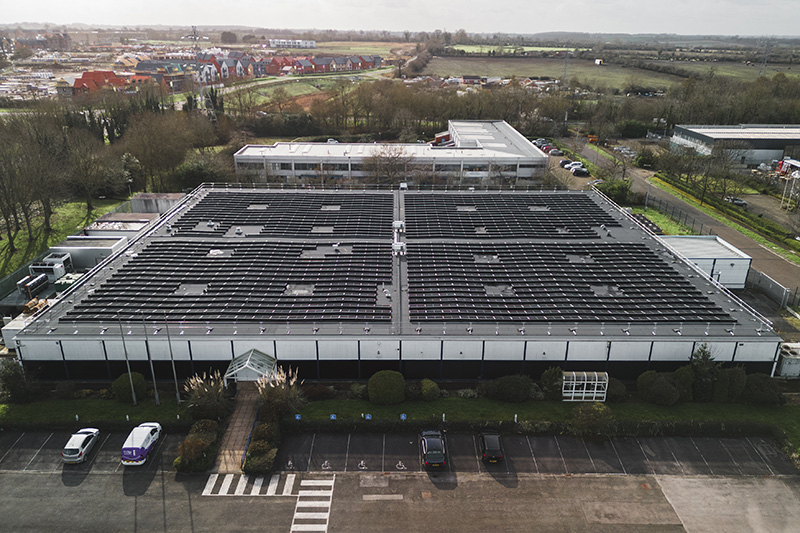
Our email marketing infrastructure is based at the Milton Keynes data centre. Its roof carries more than 1,000 solar panels, generating electricity on site and reducing the amount that needs to be drawn from the grid.
The facility also sources electricity from renewable suppliers, including wind and solar. On-site generation is one part of a wider approach to running the building more efficiently.

Solar output changes with daylight, weather and demand. On-site generation contributes to the facility’s supply; it does not mean every campaign runs entirely on solar power.
The data-centre operator describes efficiency measures spanning cooling, server configuration, water use and recycling, alongside ISO 14001 environmental management accreditation. These are facility and operator credentials.
Cooling and server configuration are part of the facility’s energy-efficiency programme.
The operator reports water-saving practices intended to reduce the resources needed to run its facilities.
Its published approach includes recycling, reducing packaging waste and reusing materials where feasible.
Environmental management gives the operator a framework for reviewing performance and identifying further changes.
If sustainability is part of your supplier review, we’re happy to talk through the infrastructure behind Email Blaster and help you understand the information available.
We do not describe Email Blaster or individual email campaigns as carbon neutral or zero impact. Renewable electricity and more efficient facilities are meaningful steps, but they are not a complete measure of a service’s environmental footprint.
Discuss your sustainability requirements →