

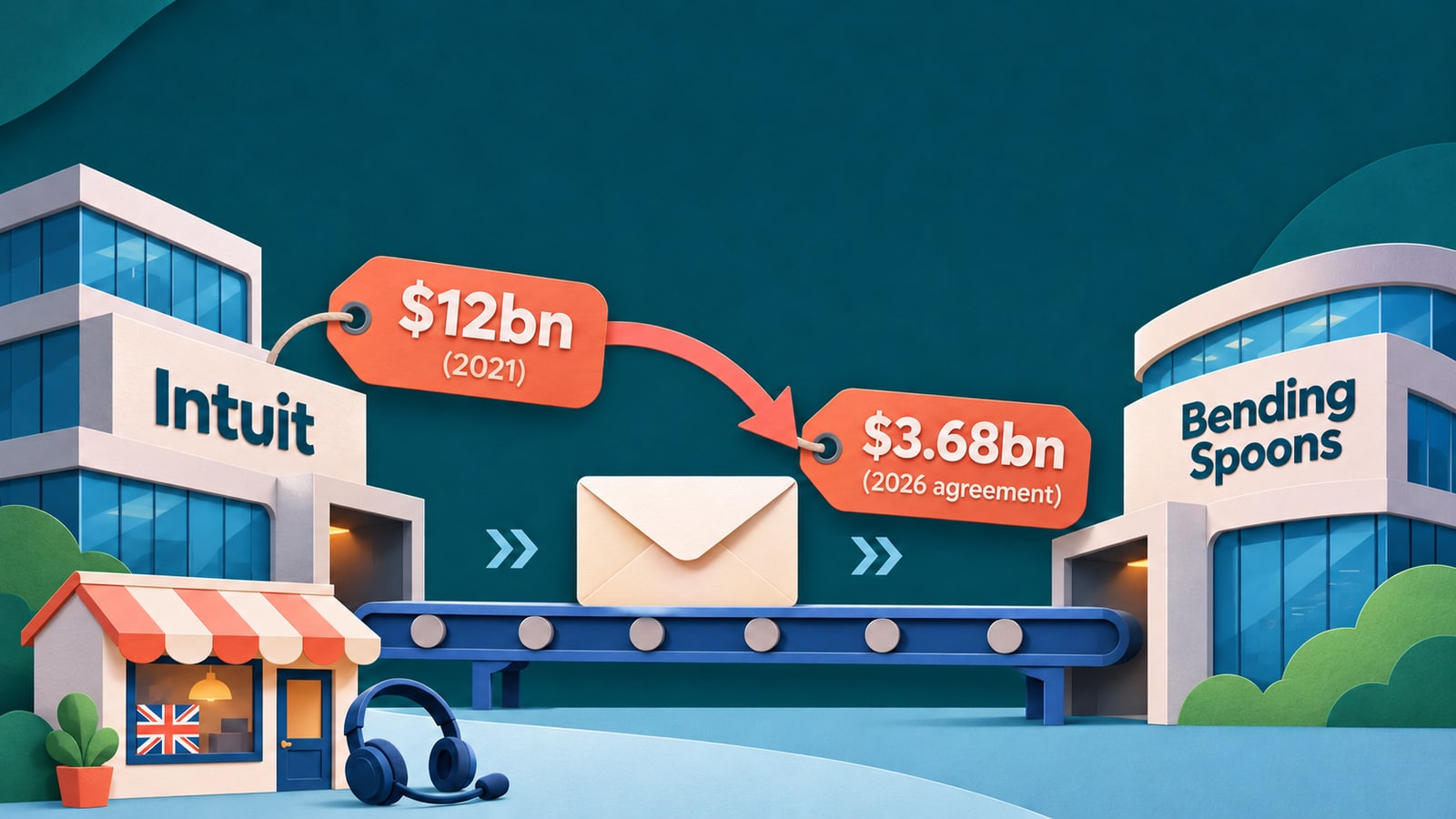
Intuit has agreed to sell Mailchimp to Bending Spoons for $3.68 billion, five years after buying it for $12 billion. For UK businesses already frustrated by pricing, a complicated workflow or disappointing support, this is a sensible moment to reconsider the platform. The deal is expected to close in early 2027; it has not completed as of 23 November 2026.
There is no need to panic or rebuild your email marketing overnight. But if your bill keeps becoming harder to justify, routine jobs feel more complicated than they should, or getting useful support has become a struggle, the announcement gives you a good reason to take stock.
This article is published by Email Blaster, a UK email marketing software provider and Mailchimp alternative. Facts and product information were checked on 23 November 2026.
From a $12 billion purchase to a $3.68 billion sale agreement
Intuit completed its Mailchimp acquisition on 1 November 2021. The $12 billion consideration comprised $5.7 billion in cash and approximately $6.3 billion in Intuit shares. Its ambition was to build an end-to-end customer growth platform for small and medium-sized businesses. See Intuit’s November 2021 SEC filing.
On 19 November 2026, Intuit announced an agreement to sell Mailchimp for approximately $3.68 billion, comprising around $3.31 billion in cash and $368 million in Bending Spoons shares, subject to closing adjustments. Regulatory approvals and other closing conditions remain. Reuters reported the agreement on 19 November.
Comparing those headline figures gives an $8.32 billion gap: the agreed sale figure is approximately 69.3% below the acquisition price. That is a stark retreat from the original investment. It is not a calculation of Intuit’s total investment return or its accounting loss on disposal; those require more than subtracting two transaction headlines.

Mailchimp is struggling to grow, but it is making operating income
For the quarter ended 31 October 2026, Mailchimp revenue was $313 million, down from $317 million a year earlier. Intuit attributed the decline to fewer paying customers and a change in customer mix, partly offset by higher effective prices.
Segment operating income nevertheless rose to $202 million from $139 million. Intuit attributed the increase to lower staffing, marketing and outside-services expenses, partly offset by lower revenue. This measure excludes certain costs recorded centrally and is not standalone net profit.
Intuit also said it expected a pre-tax gain when the sale completes, depending on the carrying value and closing factors. A lower sale price than the original purchase price therefore should not be labelled an $8.32 billion accounting loss. These details appear in Intuit’s latest quarterly SEC filing, particularly the Mailchimp segment and subsequent-events sections.
Our view is that shrinking customer numbers alongside higher effective prices should prompt a value-for-money review. The figures do not establish why individual customers left, or prove that pricing, software complexity or support caused the revenue decline.
What does a Bending Spoons takeover usually mean?
Bending Spoons describes a strategy of acquiring businesses to hold for the long term, then changing their technology, user experience, marketing, monetisation and organisation. In the Mailchimp announcement, it said it planned substantial investment. You can read the announcement in its SEC-filed release.
Its track record explains why customers are asking questions. In September 2024, for example, Reuters reported that Bending Spoons planned to cut 75% of WeTransfer’s staff following that acquisition. That report concerned WeTransfer; it is not evidence of an announced Mailchimp staffing plan.
For Mailchimp customers, the useful question is what any future changes mean for the service you pay for. Investment could improve the software. Reorganisation or changes to packages could also change your experience. Watch actual announcements about pricing, features and access to support, rather than assuming a particular outcome.
Why pricing changes have frustrated Mailchimp users
Mailchimp’s appeal to a small business used to include a generous free starting point. Its legacy-plan documentation describes an allowance of 2,000 contacts and 12,000 emails per month. The current Free plan is much smaller: up to 250 contacts and 500 sends per month, with a 250-send daily limit. These are different plan generations, rather than a promise that every legacy account has identical terms.
The paid-plan rules also deserve attention. Mailchimp’s current contact-tier guidance says subscribed, non-subscribed and unsubscribed contacts count towards the contact limit. That means your billable audience can be larger than the group you can actually send a marketing email to. Contact and sending limits can also trigger additional charges. Legacy arrangements differ, so review your own account.
For an owner who simply wants to send a useful newsletter, contact categories, send allowances, feature tiers and plan changes add decisions to an already busy day. A low introductory price is less helpful if the package becomes difficult to predict as your records grow.
Product evidence: Mailchimp’s “About Your Legacy Pricing Plan”, “About Mailchimp Pricing Plans” and “About Mailchimp Pricing Tiers”, checked on 23 November 2026.
Customer support and usability complaints are hard to ignore
At the time of our check, Mailchimp’s Trustpilot profile displayed a TrustScore of 2.5 out of 5, labelled “Poor”. Reviews included complaints about confusing pricing, frustrating support interactions and a clunky experience. That is a meaningful warning sign for a business considering putting an important marketing channel on the platform. Read the current Trustpilot profile and individual reviews.
Reviews are individual customer accounts, and positive support reviews also appear. The profile is useful evidence of dissatisfaction, rather than a survey of every Mailchimp user. The wider decline in paying customers is documented in Intuit’s results; the reasons behind each departure are not.
There is, however, a practical difference buyers can check. Mailchimp’s published support options give new Free accounts email support for their first 30 days. Essentials and Standard include chat and email support, while Premium adds telephone support. A UK sales number is not the same thing as telephone technical support included in your plan.
If a campaign stalls on a busy morning, being able to explain the problem to a helpful person can matter more than another feature on a comparison chart. Test the support route before committing: ask a specific account question and see whether you can get a useful answer through the channel you prefer.
Support entitlements checked against Mailchimp’s “Mailchimp Support Options” and Premium support documentation on 23 November 2026. Response quality varies; no guaranteed response-time comparison is claimed.
US data storage makes Mailchimp a weaker fit for some UK businesses
Mailchimp’s security documentation says its owned and operated servers are in US data centres. It also uses third-party service providers that may process personal data. An Italian buyer does not, by itself, move customer records to the UK or Europe. Check the actual contractual and technical arrangements rather than the new owner’s address.
For a UK organisation with a requirement to keep mailing data in the UK, that US infrastructure is a material mismatch. For other businesses, overseas processing introduces supplier questions: which entity receives the data, where it is processed, which subprocessors are involved and which transfer mechanism applies?
US storage does not automatically make a service unlawful under UK GDPR. The UK-US data bridge can cover qualifying transfers to appropriately certified US recipients; other safeguards may apply where it cannot be used. The UK government’s data bridge factsheet explains the conditions. Check the recipient’s current certification and scope, and get advice for your organisation’s circumstances.
UK hosting alone does not establish compliance either. You still need to review permissions, contracts, security, retention and any processing outside the core mailing-data store. The practical advantage is choosing infrastructure that fits your requirements from the outset.
Hosting evidence: Mailchimp’s “Data Security and Privacy” documentation, checked on 23 November 2026.

What should customers watch after the Bending Spoons announcement?
A new owner creates uncertainty, but it is not evidence of a specific forthcoming price rise, product cut or support reduction. Judge announced changes when they arrive. Keep a dated record of your current allowance, renewal price, essential features and support entitlement so you can compare any new terms properly.
For a UK business, we would watch four things:
- Your actual bill: introductory discounts, contact bands, send limits, overages, currency and VAT treatment.
- Access to people: whether the support channels you use remain included and whether questions get resolved.
- Everyday usability: the time needed to build, test and send your normal campaign, including workarounds.
- Data arrangements: changes to contracting entities, storage, subprocessors and transfer terms.
You do not need to wait for an ownership change to address an existing problem. If your costs are already difficult to justify, or your team regularly loses time navigating the software and seeking help, compare alternatives now.
Why we recommend Email Blaster for these UK priorities
For UK businesses prioritising UK mailing-data storage, friendly real-person UK support and straightforward monthly feature access, we recommend trying Email Blaster’s UK email marketing software. That is our recommendation as the supplier, based on those priorities.
Customer mailing data is hosted on our own UK infrastructure, and our UK team can be reached by telephone, chat or email. Every monthly plan includes all software features as standard, with unlimited contact storage, lists and users. Your sending allowance determines the monthly package; VAT is added where applicable. These arrangements let you budget around sending volume without a separate contact-storage charge. See current packages and contract terms.
For example, a business sending one newsletter to 2,000 eligible recipients uses 2,000 sends. Four equivalent newsletters use 8,000 sends. Compare the allowance you actually need, rather than treating unlimited contact storage as unlimited sending.
Explore the Email Blaster software overview, try building your usual newsletter and talk to our UK team about your requirements. Check any essential integration or automation before moving.
Prepare a careful move, rather than a rushed one
Before changing providers, preserve the evidence and records that make your campaigns work. Keep consent evidence and suppression records alongside the eligible audience, so a move does not accidentally re-subscribe people who opted out. Save the reports you need and document signup forms, integrations and automated journeys.
Map what the destination system can import and what needs rebuilding. Check domain authentication with the new provider, test with a small appropriate audience and verify that unsubscribe requests are honoured across any systems running in parallel. Confirm the new workflow before cancelling the old account.
The Mailchimp sale agreement is a useful prompt to review your options. For a UK business already dissatisfied with the price, support or software, there is a stronger reason to act: choose a service that fits how your team works and where you want your mailing data stored. Open a free Email Blaster account and try it with your next campaign brief.